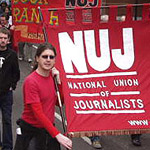
Today's Guardian Media Talk podcast features a bit of yours truly talking about my now infamous Web 2.0 article and some people talking about it (including Professor Greenslade basically describing a future that appears to be exactly what I warned about, though no-one seemed to notice).
26 October, 2007

25 October, 2007
The Journalist article
Below is the article on Web 2.0 as it appeared in The Journalist, the National Union of Journalists' magazine:
WEB 2.0 IS RUBBISH
Webfolk call the burgeoning interactive use of the internet ‘Web 2.0’, in the manner of software manufacturers numbering their products. It’s full of possibilities – and of dangers for journalism, as DONNACHA DE LONG reports
IN THE AGE of technological integration in the media, the term Web 2.0 has increasingly become common currency. Even where the term is not used, the fundamental concepts of user participation and feedback have infused many of the ideas that have gone hand-in-hand with the major changes in work practices that have excited, worried and infuriated working journalists in varying measures.
So what's wrong with it? Isn't increased participation and feedback from our "users" -- readers and viewers -- a good thing? Of course it is, but the problem with Web 2.0 is not how it introduces these elements to the media, but how it's seen as replacing traditional media.
Professional media provide users with something that we need to fight to retain – truly authoritative content. The professional journalist brings training, experience and access to a variety of sources that may be inaccessible to the average person. They have the ability to produce content that informs and fulfil an essential part of democracy – the widespread dissemination of information that allows the public to question those in charge.
The media are not perfect. More often than not, they focus on issues the public is interested in rather than those that are truly in the public interest. But those who argue that Web 2.0 is the future want to throw out the baby with the bathwater.
The Internet has always contained the potential to change the media. The ability to challenge authority, to provide an alternative narrative and to present a variety of points of view is what the Internet provides. But the idea that, instead of posting comments below a journalistic article, we get rid of the article altogether and just have the comments is truly dangerous.
There are those who claim that Web 2.0 democratises the media. It would make everyone equal, yes, but should they be? It’s like saying anyone can play for Manchester United. In one of the main examples given to explain Web 2.0, Wikipedia replaces Britannica Online. Is that the kind of democracy we want – where anyone can determine the information that the public can access, regardless of their level of knowledge, expertise or agenda?
WEB 2.0 IS RUBBISH
Webfolk call the burgeoning interactive use of the internet ‘Web 2.0’, in the manner of software manufacturers numbering their products. It’s full of possibilities – and of dangers for journalism, as DONNACHA DE LONG reports
IN THE AGE of technological integration in the media, the term Web 2.0 has increasingly become common currency. Even where the term is not used, the fundamental concepts of user participation and feedback have infused many of the ideas that have gone hand-in-hand with the major changes in work practices that have excited, worried and infuriated working journalists in varying measures.
So what's wrong with it? Isn't increased participation and feedback from our "users" -- readers and viewers -- a good thing? Of course it is, but the problem with Web 2.0 is not how it introduces these elements to the media, but how it's seen as replacing traditional media.
Professional media provide users with something that we need to fight to retain – truly authoritative content. The professional journalist brings training, experience and access to a variety of sources that may be inaccessible to the average person. They have the ability to produce content that informs and fulfil an essential part of democracy – the widespread dissemination of information that allows the public to question those in charge.
The media are not perfect. More often than not, they focus on issues the public is interested in rather than those that are truly in the public interest. But those who argue that Web 2.0 is the future want to throw out the baby with the bathwater.
The Internet has always contained the potential to change the media. The ability to challenge authority, to provide an alternative narrative and to present a variety of points of view is what the Internet provides. But the idea that, instead of posting comments below a journalistic article, we get rid of the article altogether and just have the comments is truly dangerous.
There are those who claim that Web 2.0 democratises the media. It would make everyone equal, yes, but should they be? It’s like saying anyone can play for Manchester United. In one of the main examples given to explain Web 2.0, Wikipedia replaces Britannica Online. Is that the kind of democracy we want – where anyone can determine the information that the public can access, regardless of their level of knowledge, expertise or agenda?
- Donnacha Delong is a member of the NUJ Multi-Media Commission. He represents new media journalists on the union’s National Executive Council
24 October, 2007
I got slagged off in the Torygraph
Oh joy - my piece in the Journalist (not yet available online, but let's see what I can do about that) has been slagged off on the Torygraph's blog. I should get a t-shirt.
16 July, 2007
The day the internet died
Quite honestly one of the funniest things I've seen in a very long time, the Onion strikes again:
Breaking News: All Online Data Lost After Internet Crash
Breaking News: All Online Data Lost After Internet Crash
12 July, 2007
NUJ lowers fees for local online journalists
The National Union of Journalists has lowered subscription fees for online journalists at local newspapers and radio stations in response to complaints new media workers earn less than counterparts from other media.
read more | digg story
read more | digg story
06 June, 2007
Press Gazette - New media breaks down old divisions
How are the changes in the nature of the media changing the structure of the National Union of Journalists and how is the union adapting to these changes? Read my article for the Press Gazette looking at these issues.
26 May, 2007
Chomsky in Dublin
23 May, 2007
Amnesty International blogs its report launch
Amnesty International's Report 2007 gives the organisation's view of the state of the world's human rights. This blog gives the human side - a combination of posts by people remembering key moments in their work as well as posts about preparing for, launching and promoting the report. An interesting mix to topics and voices.
read more | digg story
read more | digg story
12 May, 2007
NUJ launches Commission on Multi-Media Working
The NUJ launched its Commission on Multi-Media Working at a conference at the union’s London headquarters on 5 May 2007.
read more | digg story
read more | digg story
05 May, 2007
Blogging from the NUJ's Vice President
The Vice President of the National Union of Journalists in the UK and Ireland, James Doherty, blogs his year as VP.
read more | digg story
read more | digg story
03 May, 2007
Press Freedom Day: Global action needed to protect journalists
"All of society pays the price when journalists are killed with impunity and censorship and fear stifle expression. These are the conditions under which abuse of power and injustice will thrive." A major Amnesty International feature for Press Freedom Day, looking at attacks on journalists and press freedom around the world.
read more | digg story
read more | digg story
22 April, 2007
New Media news from the National Union of Journalists' ADM 2007
"The National Union of Journalists Centenary Annual Delegate Meeting has already received quite a lot of international attention for one issue, but for those of us in the New Media sector, there was amidst the three days of serious business, a number of key issues addressed." A round-up of new media news from the NUJ's Annual Delegate Meeting.
read more | digg story
read more | digg story
14 February, 2007
13 January, 2007
Bob Wilson's passed
I'll update this tomorrow when I've slept off the drink, but the great teacher - Robert Anton Wilson - has left the planet.
http://robertantonwilson.blogspot.com/2007/01/raw-essence.html
http://robertantonwilson.blogspot.com/2007/01/raw-essence.html
18 December, 2006
15 December, 2006
Amnesty International: Close Guantánamo
On 11 January 2007, the Guantánamo detention centre will be five years old. Outraged by this symbol of US abuse and injustice, human rights activists worldwide are joining together in solidarity with the detainees and their families, to demand once more that the US government close Guantánamo.
Read what those actitvists are doing on a new Amnesty International blog
http://blogs.amnesty.org/blogs/closeguantanamo
Read what those actitvists are doing on a new Amnesty International blog
http://blogs.amnesty.org/blogs/closeguantanamo
20 June, 2006
Yahoo! recruitment action
 The New Media Council carried out a recruitment action at Yahoo!'s London headquarters yesterday (Tuesday). As part of our on-going campaign about Yahoo!'s involvement in the imprisonment of journalists and activists in China, we wanted to invite member of Yahoo! staff to join the union and our campaign for human rights.
John and I started out with 300 flyers entitled "Yet Another Hypocritical Online Organisation" in the well-known Yahoo! colours (purple and yellow) just after five o'clock. By seven, we had none left. 100 or so invitations to the social event on Thursday ran out far sooner.
 We got a range of reactions, from people who agreed with our position and said that they had contacted their own management about it, to people who were more defensive. A couple of people asked us how we could do what we were doing and marched back in, presumably to ask security to remove us. However, while laws in this country are getting more restrictive, I don't think there's yet anything that prevents us standing on a public footpath and asking people if they'd like to take a flyer!
A number of people did engage with us, including a number of managers. They gave the corporate line that they had no option but to comply with Chinese law, to which we responded that they did have an option about doing business in a country that has a dreadful record on freedom of speech. We followed that up, though, with an explanation that we are willing to engage with the company and see how we might be able to work together to campaign for freedom of speech in China and elsewhere in the world. We pointed out that, as a trade union, the way we engage with companies is by recruiting their employees.
Now it's time sit back and let the emails (hopefully) flood in.
22 June, 2005
RSF and the OSCE propose six recommendations to ensure freedom of expression on the Internet
PRESS RELEASE - INTERNATIONAL
21 June 2005
RSF and the OSCE propose six recommendations to ensure freedom of expression on the Internet
SOURCE: Reporters sans frontières (RSF), Paris
(RSF/IFEX) - The following is a 20 June 2005 RSF press release:
Reporters Without Borders and the Organisation for Security and Cooperation in Europe (OSCE) make six recommendations to ensure freedom of expression on the Internet
This declaration by Reporters Without Borders and the representative of the OSCE on Freedom of the Media aims to deal with the main issues facing countries seeking to regulate online activity. Should the Web be filtered? Can online publications be forced to register with the authorities? What should the responsibility of service providers (ISPs) be? How far does a national jurisdiction extend?
Reporters Without Borders thinks these six recommendations go beyond Europe and concern every country. It hopes they will provoke discussion in the run-up to the World Summit on the Information Society (WSIS).
Full text of the Declaration:
1. Any law about the flow of information online must be anchored in the right to freedom of expression as defined in Article 19 of the Universal Declaration of Human Rights.
2. In a democratic and open society it is up to the citizens to decide what they wish to access and view on the Internet. Filtering or rating of online content by governments is unacceptable. Filters should only be installed by Internet users themselves. Any policy of filtering, be it at a national or local level, conflicts with the principle of free flow of information.
3. Any requirement to register websites with governmental authorities is not acceptable. Unlike licensing scarce resources such as broadcasting frequencies, an abundant infrastructure like the Internet does not justify official assignment of licenses. On the contrary, mandatory registration of online publications might stifle the free exchange of ideas, opinions, and information on the Internet.
4. A technical service provider must not be held responsible for the mere conduit or hosting of content unless the hosting provider refuses to obey a court ruling. A decision on whether a website is legal or illegal can only be taken by a judge, not by a service provider. Such proceedings should guarantee transparency, accountability and the right to appeal.
5. All Internet content should be subject to the legislation of the country of its origin ("upload rule") and not to the legislation of the country where it is downloaded.
6. The Internet combines various types of media, and new publishing tools such as blogging are developing. Internet writers and online journalists should be legally protected under the basic principle of the right to freedom of expression and the complementary rights of privacy and protection of sources.
For further information, contact Julien Pain, RSF Internet Desk, 5, rue Geoffroy Marie, Paris 75009, France, tel: +33 1 44 83 84 71, fax: +33 1 45 23 11 51, e-mail: internet@rsf.org, Internet: http://www.internet.rsf.org
The information contained in this press release is the sole responsibility of RSF. In citing this material for broadcast or publication, please credit RSF. _________________________________________________________________
DISTRIBUTED BY THE INTERNATIONAL FREEDOM OF EXPRESSION EXCHANGE (IFEX) CLEARING HOUSE
489 College Street, Suite 403, Toronto (ON) M6G 1A5 CANADA
tel: +1 416 515 9622 fax: +1 416 515 7879 alerts e-mail: alerts@ifex.org
general e-mail: ifex@ifex.org
Internet site: http://www.ifex.org/
21 June 2005
RSF and the OSCE propose six recommendations to ensure freedom of expression on the Internet
SOURCE: Reporters sans frontières (RSF), Paris
(RSF/IFEX) - The following is a 20 June 2005 RSF press release:
Reporters Without Borders and the Organisation for Security and Cooperation in Europe (OSCE) make six recommendations to ensure freedom of expression on the Internet
This declaration by Reporters Without Borders and the representative of the OSCE on Freedom of the Media aims to deal with the main issues facing countries seeking to regulate online activity. Should the Web be filtered? Can online publications be forced to register with the authorities? What should the responsibility of service providers (ISPs) be? How far does a national jurisdiction extend?
Reporters Without Borders thinks these six recommendations go beyond Europe and concern every country. It hopes they will provoke discussion in the run-up to the World Summit on the Information Society (WSIS).
Full text of the Declaration:
1. Any law about the flow of information online must be anchored in the right to freedom of expression as defined in Article 19 of the Universal Declaration of Human Rights.
2. In a democratic and open society it is up to the citizens to decide what they wish to access and view on the Internet. Filtering or rating of online content by governments is unacceptable. Filters should only be installed by Internet users themselves. Any policy of filtering, be it at a national or local level, conflicts with the principle of free flow of information.
3. Any requirement to register websites with governmental authorities is not acceptable. Unlike licensing scarce resources such as broadcasting frequencies, an abundant infrastructure like the Internet does not justify official assignment of licenses. On the contrary, mandatory registration of online publications might stifle the free exchange of ideas, opinions, and information on the Internet.
4. A technical service provider must not be held responsible for the mere conduit or hosting of content unless the hosting provider refuses to obey a court ruling. A decision on whether a website is legal or illegal can only be taken by a judge, not by a service provider. Such proceedings should guarantee transparency, accountability and the right to appeal.
5. All Internet content should be subject to the legislation of the country of its origin ("upload rule") and not to the legislation of the country where it is downloaded.
6. The Internet combines various types of media, and new publishing tools such as blogging are developing. Internet writers and online journalists should be legally protected under the basic principle of the right to freedom of expression and the complementary rights of privacy and protection of sources.
For further information, contact Julien Pain, RSF Internet Desk, 5, rue Geoffroy Marie, Paris 75009, France, tel: +33 1 44 83 84 71, fax: +33 1 45 23 11 51, e-mail: internet@rsf.org, Internet: http://www.internet.rsf.org
The information contained in this press release is the sole responsibility of RSF. In citing this material for broadcast or publication, please credit RSF. _________________________________________________________________
DISTRIBUTED BY THE INTERNATIONAL FREEDOM OF EXPRESSION EXCHANGE (IFEX) CLEARING HOUSE
489 College Street, Suite 403, Toronto (ON) M6G 1A5 CANADA
tel: +1 416 515 9622 fax: +1 416 515 7879 alerts e-mail: alerts@ifex.org
general e-mail: ifex@ifex.org
Internet site: http://www.ifex.org/
Subscribe to:
Posts (Atom)