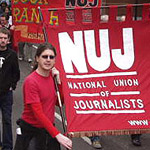
Showing posts with label NUJ. Show all posts
Showing posts with label NUJ. Show all posts
21 April, 2008
I've moved to Wordpress
I've decided to start doing this whole blogging thing properly, so I felt I needed a fresh site to do it on. Check out my latest musings on my new Wordpress blog: The revolution will be streamed.

08 November, 2007
A blast from the past
As the controversy about my article continues to rumble around a corner of the web, I thought I'd point to an article I wrote in my role as editor of news.amnesty back on Press Freedom Day 2005:
Press Freedom Day: Human rights in the Blogosphere
For all those who criticised my piece with ridiculous claims and misrepresentations, read that and then reread my article - there's no contradiction in my mind.
Update:
Also worth reading
Berners-Lee calls for Web 2.0 calm
Press Freedom Day: Human rights in the Blogosphere
For all those who criticised my piece with ridiculous claims and misrepresentations, read that and then reread my article - there's no contradiction in my mind.
Update:
Also worth reading
Berners-Lee calls for Web 2.0 calm
31 October, 2007
Remember, remember the fifth of November
Don't forget to Stand up for Journalism on Monday.
http://www.standupforjournalism.org.uk/
Read what Michelle Stanistreet, NUJ President, wrote for journalism.co.uk.
http://www.standupforjournalism.org.uk/
Read what Michelle Stanistreet, NUJ President, wrote for journalism.co.uk.
30 October, 2007
Radio appearance this time
Following on from the Guardian blog, this controversy has put me back on radio for the first time in many years! BBC Radio 5 Live's Pods & Blogs interviewed me for last night's show and the Podcast is now available.
26 October, 2007
Guardian Podcast appearance
Today's Guardian Media Talk podcast features a bit of yours truly talking about my now infamous Web 2.0 article and some people talking about it (including Professor Greenslade basically describing a future that appears to be exactly what I warned about, though no-one seemed to notice).
25 October, 2007
The Journalist article
Below is the article on Web 2.0 as it appeared in The Journalist, the National Union of Journalists' magazine:
WEB 2.0 IS RUBBISH
Webfolk call the burgeoning interactive use of the internet ‘Web 2.0’, in the manner of software manufacturers numbering their products. It’s full of possibilities – and of dangers for journalism, as DONNACHA DE LONG reports
IN THE AGE of technological integration in the media, the term Web 2.0 has increasingly become common currency. Even where the term is not used, the fundamental concepts of user participation and feedback have infused many of the ideas that have gone hand-in-hand with the major changes in work practices that have excited, worried and infuriated working journalists in varying measures.
So what's wrong with it? Isn't increased participation and feedback from our "users" -- readers and viewers -- a good thing? Of course it is, but the problem with Web 2.0 is not how it introduces these elements to the media, but how it's seen as replacing traditional media.
Professional media provide users with something that we need to fight to retain – truly authoritative content. The professional journalist brings training, experience and access to a variety of sources that may be inaccessible to the average person. They have the ability to produce content that informs and fulfil an essential part of democracy – the widespread dissemination of information that allows the public to question those in charge.
The media are not perfect. More often than not, they focus on issues the public is interested in rather than those that are truly in the public interest. But those who argue that Web 2.0 is the future want to throw out the baby with the bathwater.
The Internet has always contained the potential to change the media. The ability to challenge authority, to provide an alternative narrative and to present a variety of points of view is what the Internet provides. But the idea that, instead of posting comments below a journalistic article, we get rid of the article altogether and just have the comments is truly dangerous.
There are those who claim that Web 2.0 democratises the media. It would make everyone equal, yes, but should they be? It’s like saying anyone can play for Manchester United. In one of the main examples given to explain Web 2.0, Wikipedia replaces Britannica Online. Is that the kind of democracy we want – where anyone can determine the information that the public can access, regardless of their level of knowledge, expertise or agenda?
WEB 2.0 IS RUBBISH
Webfolk call the burgeoning interactive use of the internet ‘Web 2.0’, in the manner of software manufacturers numbering their products. It’s full of possibilities – and of dangers for journalism, as DONNACHA DE LONG reports
IN THE AGE of technological integration in the media, the term Web 2.0 has increasingly become common currency. Even where the term is not used, the fundamental concepts of user participation and feedback have infused many of the ideas that have gone hand-in-hand with the major changes in work practices that have excited, worried and infuriated working journalists in varying measures.
So what's wrong with it? Isn't increased participation and feedback from our "users" -- readers and viewers -- a good thing? Of course it is, but the problem with Web 2.0 is not how it introduces these elements to the media, but how it's seen as replacing traditional media.
Professional media provide users with something that we need to fight to retain – truly authoritative content. The professional journalist brings training, experience and access to a variety of sources that may be inaccessible to the average person. They have the ability to produce content that informs and fulfil an essential part of democracy – the widespread dissemination of information that allows the public to question those in charge.
The media are not perfect. More often than not, they focus on issues the public is interested in rather than those that are truly in the public interest. But those who argue that Web 2.0 is the future want to throw out the baby with the bathwater.
The Internet has always contained the potential to change the media. The ability to challenge authority, to provide an alternative narrative and to present a variety of points of view is what the Internet provides. But the idea that, instead of posting comments below a journalistic article, we get rid of the article altogether and just have the comments is truly dangerous.
There are those who claim that Web 2.0 democratises the media. It would make everyone equal, yes, but should they be? It’s like saying anyone can play for Manchester United. In one of the main examples given to explain Web 2.0, Wikipedia replaces Britannica Online. Is that the kind of democracy we want – where anyone can determine the information that the public can access, regardless of their level of knowledge, expertise or agenda?
- Donnacha Delong is a member of the NUJ Multi-Media Commission. He represents new media journalists on the union’s National Executive Council
24 October, 2007
I got slagged off in the Torygraph
Oh joy - my piece in the Journalist (not yet available online, but let's see what I can do about that) has been slagged off on the Torygraph's blog. I should get a t-shirt.
06 June, 2007
Press Gazette - New media breaks down old divisions
How are the changes in the nature of the media changing the structure of the National Union of Journalists and how is the union adapting to these changes? Read my article for the Press Gazette looking at these issues.
12 May, 2007
NUJ launches Commission on Multi-Media Working
The NUJ launched its Commission on Multi-Media Working at a conference at the union’s London headquarters on 5 May 2007.
read more | digg story
read more | digg story
05 May, 2007
Blogging from the NUJ's Vice President
The Vice President of the National Union of Journalists in the UK and Ireland, James Doherty, blogs his year as VP.
read more | digg story
read more | digg story
22 April, 2007
New Media news from the National Union of Journalists' ADM 2007
"The National Union of Journalists Centenary Annual Delegate Meeting has already received quite a lot of international attention for one issue, but for those of us in the New Media sector, there was amidst the three days of serious business, a number of key issues addressed." A round-up of new media news from the NUJ's Annual Delegate Meeting.
read more | digg story
read more | digg story
Subscribe to:
Posts (Atom)